
Wrong fuel in the tank:
What to do now.
Petrol in a diesel car, diesel in a petrol car, E10 instead of E5: what to do straight away, what misfuelling costs, who pays and how to prevent it in future.
Misfuelling means putting the wrong fuel in the tank, for example petrol in a diesel car, diesel in a petrol car, E10 instead of E5, or AdBlue in a diesel tank. According to the German magazine auto motor und sport, it happens more than 200,000 times a year in Germany. What matters is what you do in the first few minutes.
What should you do if you have put the wrong fuel in?
The most important step: don't start the engine. As long as the wrong fuel stays in the tank, pumping it out is usually all that is needed.
Stop immediately
As soon as you notice the mistake: put the nozzle back and don't keep refuelling.
Keep the engine off
Don't start the engine, don't even switch on the ignition, and if possible don't open the driver's door. In many cars, the fuel pump already kicks in at that point.
Get help
Check the owner's manual and call your breakdown service or authorised workshop. Usually the tank is simply pumped out.
Already driven off?
Stop in a safe place as soon as possible and switch the engine off.
Source: ADAC (Germany's largest automobile club), as of August 2025. Please also follow the instructions in your vehicle's owner's manual.
Petrol in a diesel car
This is the more expensive case and the more common one, because the slimmer petrol nozzle fits into the diesel filler neck. Petrol breaks down the lubricating film that the high-pressure pump and injectors depend on. Modern direct-injection diesels are particularly sensitive. If the engine has already run, in the worst case the entire injection system has to be replaced.
Diesel in a petrol car
Less common, but possible: the diesel nozzle can often be inserted into the upper part of the filler neck. Diesel puts a strain on the injection system and the exhaust aftertreatment. Depending on the quantity, the tank has to be pumped out; with only a little diesel, ADAC says that driving on carefully and topping up with the right fuel is sometimes enough. Clarify this with a workshop first.
Even E10 in a car without E10 approval can cause damage after a single tank, and AdBlue in a diesel tank attacks the lines and the pump. In both cases: keep the engine off and ask a workshop.
How often does misfuelling happen, and where?
- Germany200,000auto motor und sport
- United Kingdom133,000comparethemarket.com
- France100,000Autosphere, estimate 2025
- Spain72,700RACE, projection 2016
- Netherlands25,000NRC
- Belgium18,000Touring
- Norway15,000If
- Austria14,000ÖAMTC
- Switzerland10,000TCS
Cases of misfuelling per year. Misfuelling is generally not counted as a breakdown, doesn't necessarily involve the automobile club and is usually not an insurance claim, so there are no precise statistics. The real figure is probably many times higher, because petrol stations, workshops or specialist pump-out services often help.
What does misfuelling cost?
- €150–500
- Pump-out, with towing and disposal depending on the effort involved, if the engine was not running German figures: R+V: €150–300 for pumping out · Autoflotte 5/2021: €300–500 including towing and disposal
- Several thousand euros
- New injection system if petrol in a diesel car has already run through the engine ADAC
- €10,000–15,000
- per misfuelled ambulance DRK-Kreisverband Lüneburg
Does insurance pay?
In most cases, no. In Germany, insurers classify misfuelling as operating damage (Betriebsschaden). Motor liability insurance, Teilkasko (partially comprehensive) and Vollkasko (fully comprehensive) then don't pay, whether it is a private car, a rental car or a company car (R+V, as of May 2025). In many other European countries, too, motor insurance often doesn't cover misfuelling damage, or only part of it. Generally speaking, manufacturer warranties don't cover damage caused by the wrong fuel either (for example the Volkswagen new-car warranty in Germany).
There are exceptions. In Germany, some breakdown-cover packages (Schutzbrief) pay for pumping out and towing up to a maximum amount, VGH for example up to €500, according to a VGH insurance agent in our video. A few add-on options from German insurers, such as HUK-COBURG's Kasko PLUS, have also covered misfuelling damage since August 2025. It is worth checking the terms of your own policy before it happens.
Does the diesel nozzle fit into a petrol car?
Most often it is a diesel car that gets filled with petrol, because technically that is the easiest mistake to make: at 21 mm, the petrol nozzle is slimmer than the diesel nozzle at 25 mm and fits easily into the filler opening of a diesel.
Conversely, according to ADAC, many current models from well-known manufacturers can also be filled with diesel by mistake, despite the thicker nozzle.
- Petrol
- 21 mm
- Diesel
- 25 mm
The most common causes
- Distraction and lack of concentration
- Stress, time pressure or tiredness on night drives
- Several fuel grades at one pump (multi-dispenser)
- Confusing labelling on the pump nozzles
- Unfamiliar fuel names abroad, such as DERV, Nafta or Gazole
- Stress from traffic jams or summer heat
- Force of habit when switching between vehicles: company car, second car, borrowed car
Diesel isn't called diesel everywhere
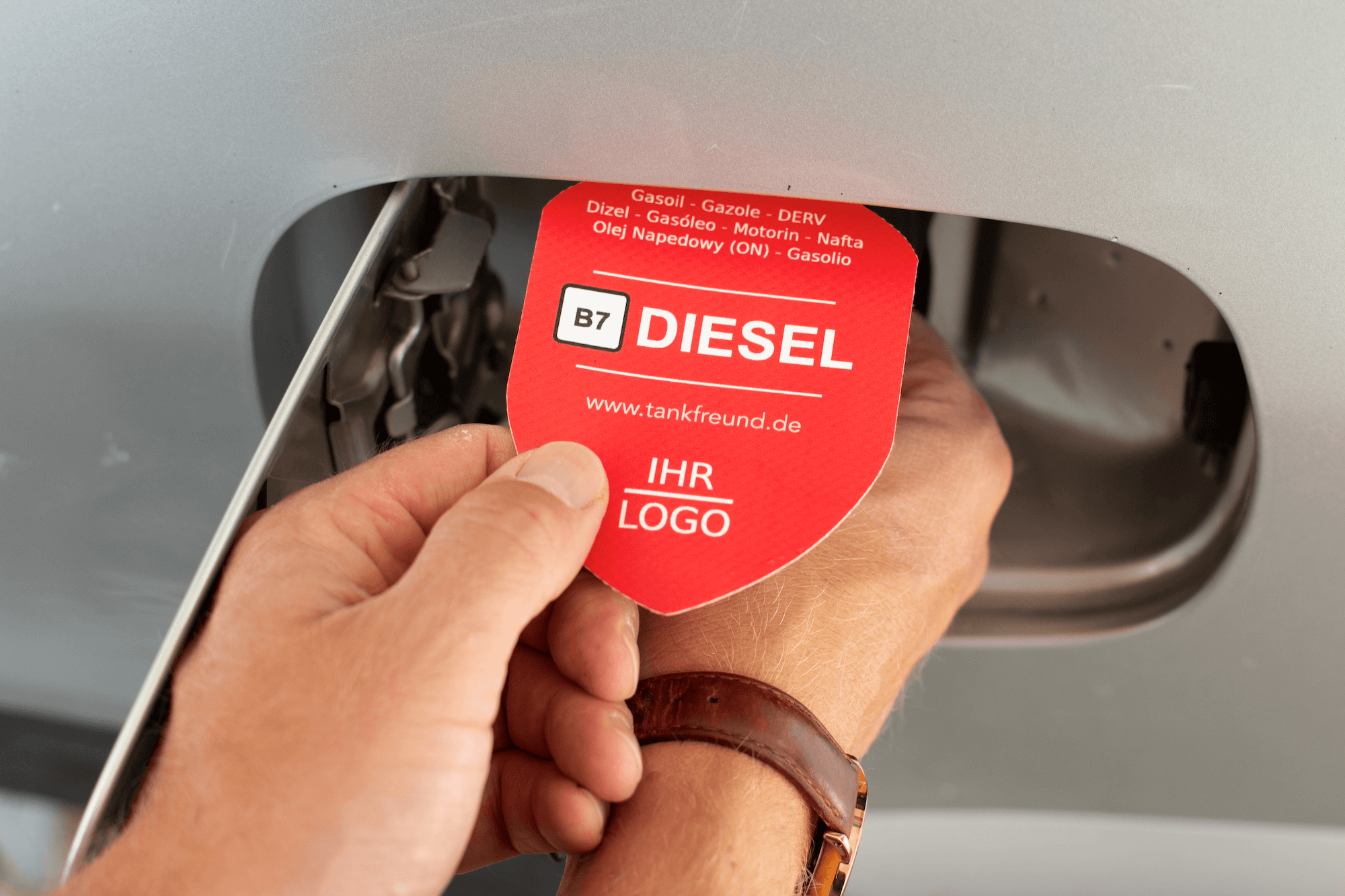
Abroad, the names on the pump are different. The Tankfreund lists the fuel names used in the main travel destinations.
How the Tankfreund protects
Impossible to miss
It hangs above the fuel cap. Whoever wants to refuel has to lift it and sees the right fuel.
For every fuel
B7 diesel, HVO, E5 and E10, with the fuel names of the main travel destinations.
Fitted in 2 minutes
Self-adhesive, no tools needed, for all common cars and vans.
Questions about misfuelling
Further answers on product, fitting and ordering can be found in the FAQ.
All questionsWhich is worse: petrol in a diesel car or diesel in a petrol car?
Petrol in a diesel car. Petrol breaks down the lubricating film that the high-pressure pump and injectors need; modern direct-injection diesels are particularly sensitive. Diesel in a petrol car puts strain on the injection system and exhaust aftertreatment; with only a little diesel, according to ADAC (Germany's largest automobile club), topping up with the right fuel is sometimes enough.
What does misfuelling cost?
In Germany, pumping out costs roughly €150 to €500, depending on whether the car has to be towed and the fuel disposed of. If the engine has already been running, the injection system often has to be replaced; according to ADAC, that costs several thousand euros.
Is misfuelling classed as operating damage?
In Germany, yes. Insurers classify misfuelling as operating damage. Motor liability insurance and partial or fully comprehensive cover (Teilkasko, Vollkasko) then generally don't pay, not even for rental cars or company cars (R+V, a German insurer, as of May 2025). In many other European countries, too, motor insurance often doesn't cover misfuelling damage, or only part of it (for example in the UK, France and the Netherlands).
Does a Schutzbrief (breakdown cover) pay out for misfuelling?
Some breakdown cover packages (in Germany, a “Schutzbrief”) pay for pumping out and towing up to a maximum amount; VGH, a German insurer, for example pays up to €500, according to a VGH insurance agent in our video. Breakdown cover generally doesn't pay for engine damage. What exactly applies is set out in your policy terms.
Company car misfuelled: who pays?
That depends on how serious the mistake is, and the rules differ from country to country. In Germany, for example, employee liability is graded: for a minor slip the employer bears the damage, for medium negligence it is shared, and for gross negligence the driver generally bears the full amount (Heuking, 2024). German courts have repeatedly treated misfuelling a company vehicle as grossly negligent, most recently the Federal Administrative Court in 2017 in the case of a police officer who had put petrol in a diesel vehicle. In many European countries, motor insurance often doesn't cover misfuelling damage, or only part of it, for example in the UK, France, the Netherlands and Germany.
Test first,
then decide.
We will send you a few Tankfreund tags free of charge to try out.
- Free of charge
- In the fuel you need
- No obligation